
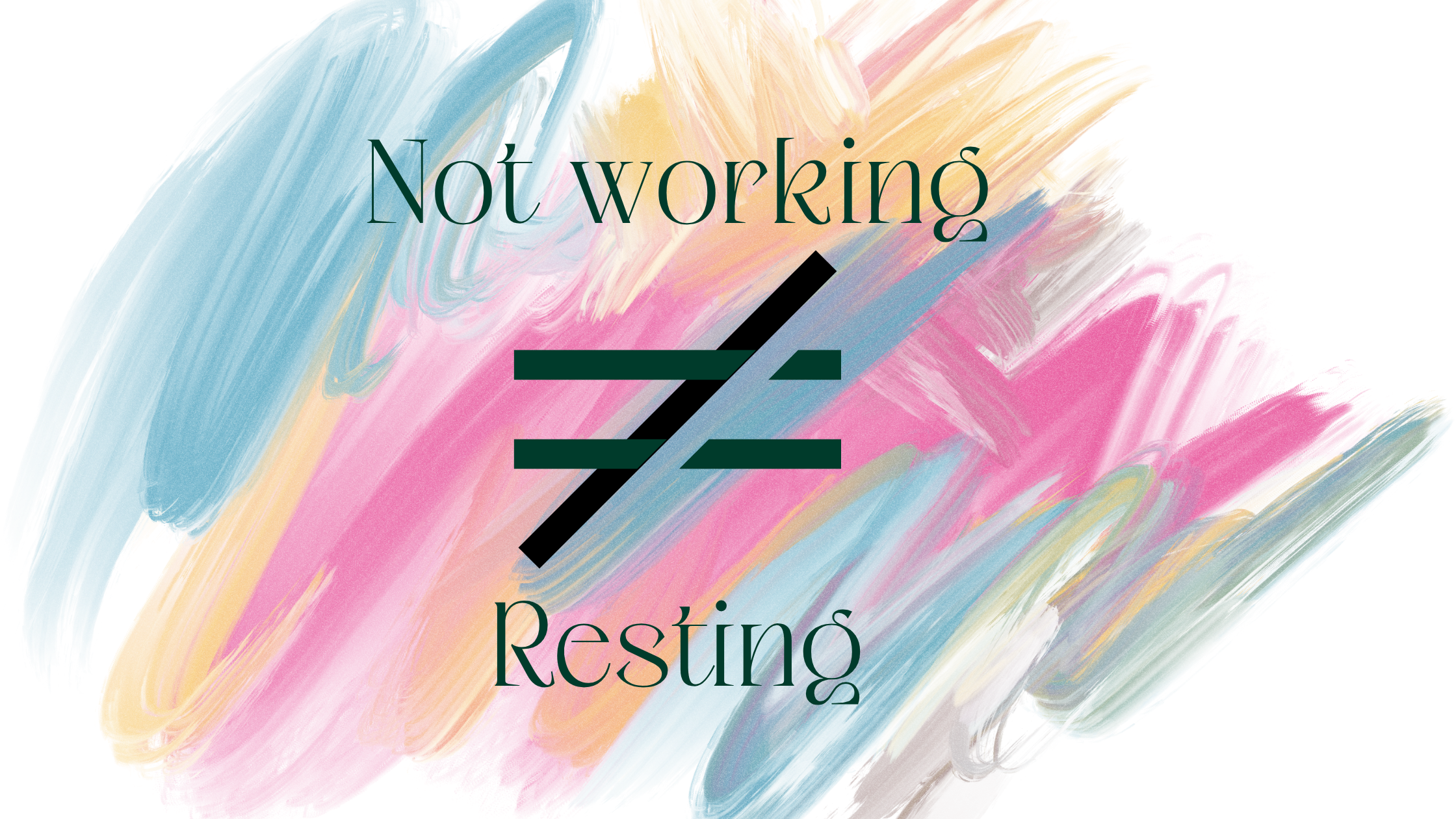
How Rested Are You — Really?
On a scale of 0 to 10 — how rested do you actually feel right now?
Not ‘how much sleep did you get.’ Not ‘how productive have you been.’ How rested.
Now a second question — and this one tends to land harder:
When was the last time you felt truly rested?
Take a moment with that.
For many women, the answer is somewhere between ‘I’m not sure’ and ‘I genuinely can’t remember.’ Some realise it was months ago. Some trace it back to before the promotion, the baby, the business launch — before life got this full.
If that landed like a quiet wake-up call, good. That’s exactly what it’s meant to be.
Your exhaustion is not a personal failure.
It’s not a discipline problem or a morning routine problem. It’s a signal. And it deserves to be taken seriously. Because rest is not something you have to earn, justify, or schedule in when everything else is done. It is a birthright. And somewhere along the way, most women got subtly talked out of claiming it.
This article is about that signal — what it means, why rest is uniquely hard for women, and what becomes possible when you finally answer it.
Rest isn’t something you earn after everything is done. It’s the foundation everything else is built on.
Let’s start there.
The Problem — Women Leading from High-Functioning Survival
You look capable. You are capable.
And yet — something doesn’t feel right..
This is what I call High-Functioning Survival: the place where you’re productive, praised, and quietly falling apart.
You oscillate between overdrive and collapse. You push through because stopping feels more frightening than exhaustion. You’ve lost your spark — but you keep going because people are counting on you.
Sounds familiar?
Here’s what I know from working with hundreds of high-achieving women: this isn’t a character flaw. It’s a nervous system response. And it’s also the result of a world that has consistently taught women that their worth is measured by their output, and that rest is something other people get to have.
Most women in this place try to grow, scale, and lead while running on empty. They build strategy on top of depletion. But you cannot create sustainable success when your nervous system is stuck in survival mode.
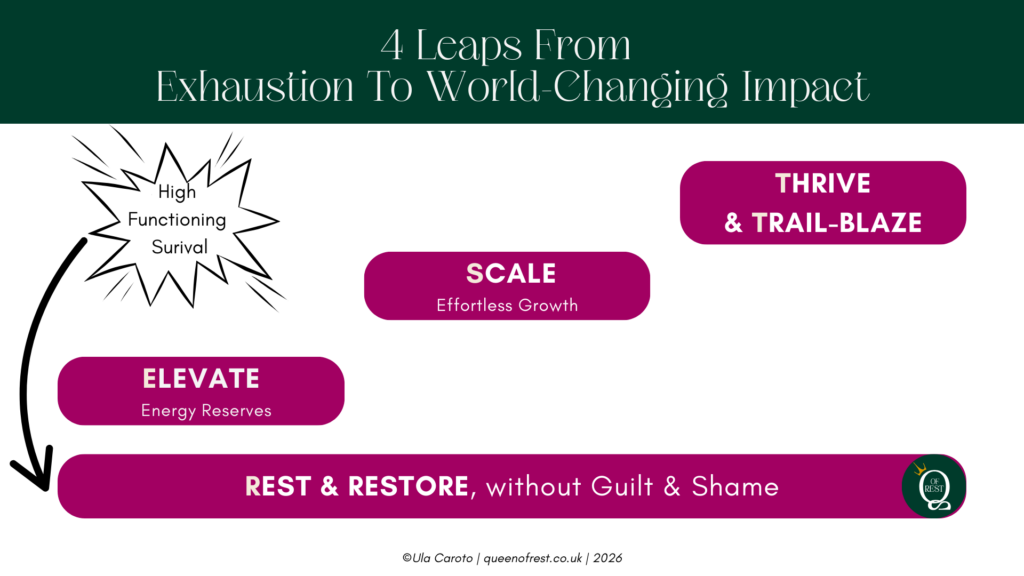
The journey out doesn’t start with doing more.
It starts with the first leap: Rest and Restore — without guilt or shame.
Why Rest Isn’t Landing — And What’s Actually Missing
Here’s something most people don’t know — and it changes everything:
You can create the conditions for rest and still not feel rested.
Does this sound familiar?
You finally get a quiet evening, a slow morning, a holiday. And instead of unwinding, your mind races. Your body stays braced. You can’t switch off.
This isn’t a willpower problem. It’s a nervous system problem. When your system is stuck in survival mode — what I call the ‘foot on the accelerator, tank on empty’ state — rest simply doesn’t land. Your body doesn’t know it’s safe to let go. This is why nervous system regulation is rest’s essential partner.
There are two levels of this work:
- Short-term resets — small, accessible practices that bring your nervous system back from the edge (like the physiological sigh, sensory pauses, or stepping outside).
- Longer-term befriending and rewiring — deepening awareness of your system and expanding capacity and resilience so thriving, not coping, is your default setting.
Rest restores. Regulation makes restoration possible.
Until your nervous system gets the signal that it’s safe — real rest will keep feeling out of reach.
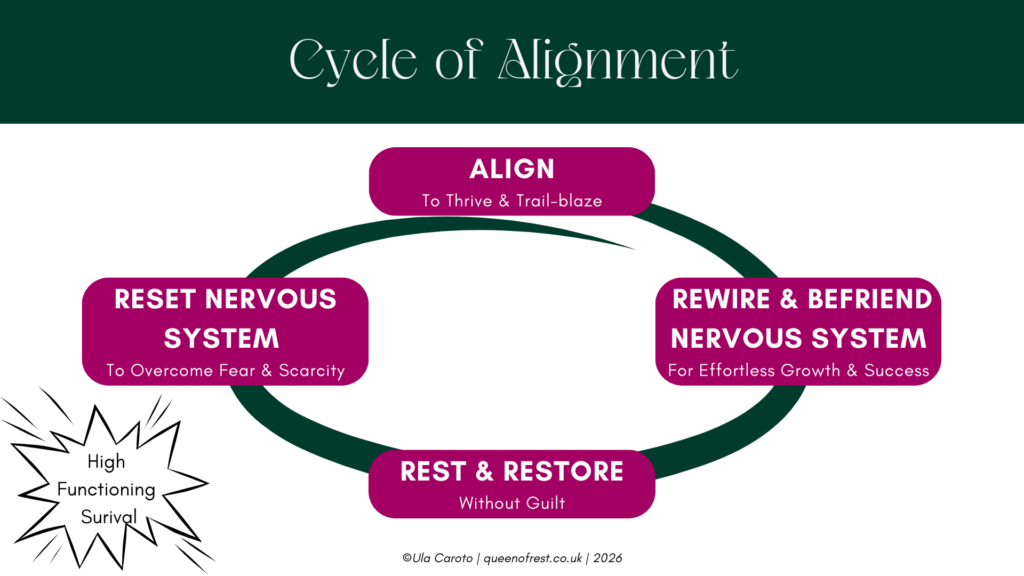
It starts with the first leap: Rest and Restore — without guilt or shame.
Why Rest Is Uniquely Hard for Women
Let’s be honest about something.
Rest isn’t hard for women because they’re doing it wrong. It’s hard because of what they’ve been taught to believe about it.
In my work, every challenge women bring to rest distils into three core experiences:
- Fear. If I stop, everything will fall apart. Or worse — I’ll feel everything I’ve been avoiding.
- Shame and guilt. Rest is selfish. Needing rest means I’m weak, lazy, or falling behind. Even wanting rest feels indulgent.
- Scarcity. There’s no time. I need to keep going to make a living. I’m not enough. I’ll rest when everything is done — which, of course, it never is.
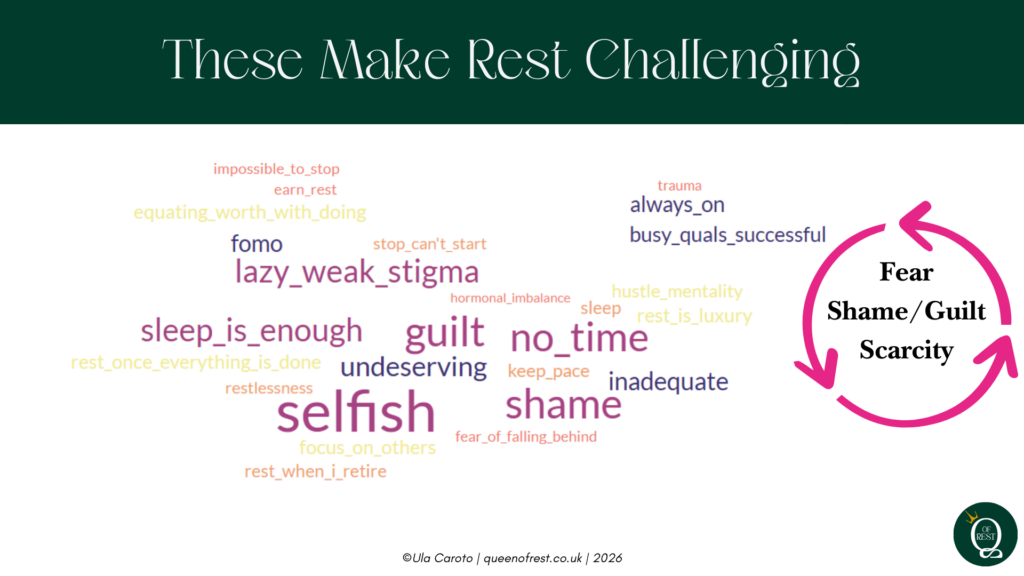
Here’s what makes this particularly hard: these three don’t just coexist. They feed each other.
Fear drives you to keep going. Exhaustion deepens the scarcity. Shame stops you from honouring your needs. And round it goes.
For women, there’s an added layer. Many of us absorbed the message early — from family, culture, or workplace — that our value is tied to our output. That caring for ourselves comes last. That being always on is something to be proud of.
It isn’t. It’s a recipe for burnout.
And here’s the thing I see again and again with my clients: the women who look the most capable are often the ones running closest to empty.
Take a moment with this: Growing up — what was your experience of rest? What was your caretakers’ relationship with rest like — what beliefs did they hold about rest and what examples did they set? Was it encouraged, or was it something you had to earn? Was stillness safe — or did it feel uncomfortable, even unsafe?
Many of us are still living by rules we didn’t consciously choose.
The good news? They can be rewritten.
| 📌 A note for you:And if you’re a woman from a marginalised community, or you’re neurodivergent, know this: these barriers don’t just feel harder — they are harder. Chronic systemic stress and the daily effort of navigating a world not designed for you place a unique load on your nervous system. Rest isn’t a nice-to-have for you. It’s non-negotiable. |
The Two Cycles — Depletion or Enoughness. Which Are You In?
At the heart of this work is a simple but radical idea: you are worthy of rest not because you’ve earned it, but because you exist.
You see, there’s a cycle most high-achieving women don’t realise they’re stuck in.
It starts with tiredness. Not just physical tiredness — but the deeper kind. The kind that comes from constantly overriding your own needs.
The Vicious Cycle of Tiredness works like this:
When we ignore our need for rest, we’re sending ourselves a message — often without realising it — that our needs don’t matter. Over time, that message becomes a belief: I’m not important enough. I’m not enough.
And here’s the cruel irony: the less worthy we feel, the harder it becomes to rest. So we push through. Deplete further. The scarcity grows. The tiredness deepens.
Round and round it goes.
But there’s another cycle available to you.
The Virtuous Cycle of Rest begins with one small act of self-permission.
When you give yourself rest — even a micro-moment of it — you send a different message: my needs matter. I am enough.
That single shift begins to replenish your inner resources. From that place of enoughness, rest starts to feel more possible. More deserved. And each time you choose it, you reinforce your own worth.
Rest builds enoughness. Enoughness makes rest possible.
This is not a luxury loop. It’s a biological one. And it’s available to every woman — starting now.
Reflection: Which cycle are you currently in? And what would one small act of rest — chosen with intention — say to you today?
What Chronic Stress Does to Women’s Bodies — The Hormone Hierarchy
If you’ve ever felt like you’re doing everything right — eating well, exercising, maybe even taking HRT — and you’re still exhausted, there’s a biological reason.
It’s called the Hormone Hierarchy. And until you understand it, you’ll keep trying to fix the wrong thing.
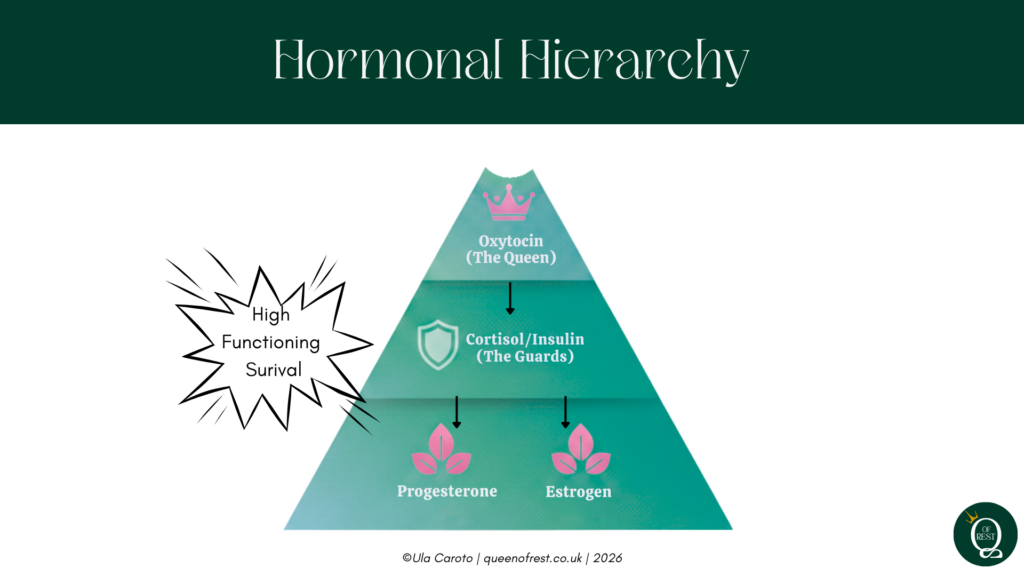
At the top: Oxytocin — The Queen 👑
Oxytocin is the master key. When you access genuine rest and safety, you activate her. She signals to your entire system: it’s safe to thrive. Without her on the throne, everything below is compromised.
In the middle: Cortisol & Insulin — The Guards
In High-Functioning Survival, the Guards have staged a coup. Cortisol — designed as a short-term emergency responder — becomes a permanent resident. This creates a Cortisol-Insulin loop: high cortisol raises blood sugar, insulin spikes to manage it. This is why you might be gaining weight, experiencing brain fog, or feeling wired but exhausted — even when your diet is perfect.
At the base: Estrogen, Progesterone — The Sabotaged Players
These hormones govern your mood, libido, bone health, cycle regulation, and spark. But in survival mode, your body steals their building blocks to make more cortisol. It’s biological sabotage.
This is why you cannot fix a hormonal imbalance by looking at sex hormones alone. If the Guards are on high alert, the sex hormones never get the signal to play.
This matters across every stage of a woman’s life — from PMS and cycle irregularities, to perimenopause and menopause. Chronic stress doesn’t just make these transitions harder. It accelerates them.
The way through isn’t more supplements or more willpower. It’s signalling safety to your nervous system — so the Queen can return to the throne, the Guards can stand down, and your natural hormonal rhythm can restore itself.
Reflection: Have you ever tried to fix your energy, hormones, or sleep — without addressing the stress underneath? What might shift if you started there instead?
You Don’t Have One Energy Battery. You Have Seven.
Most people think rest means sleep.
And yes — sleep matters enormously. But if sleep were the whole answer, you wouldn’t be reading this still feeling tired.
Here’s the truth: your energy isn’t powered by a single battery. You have seven. And just like your remote control, when one runs critically low — everything slows down.
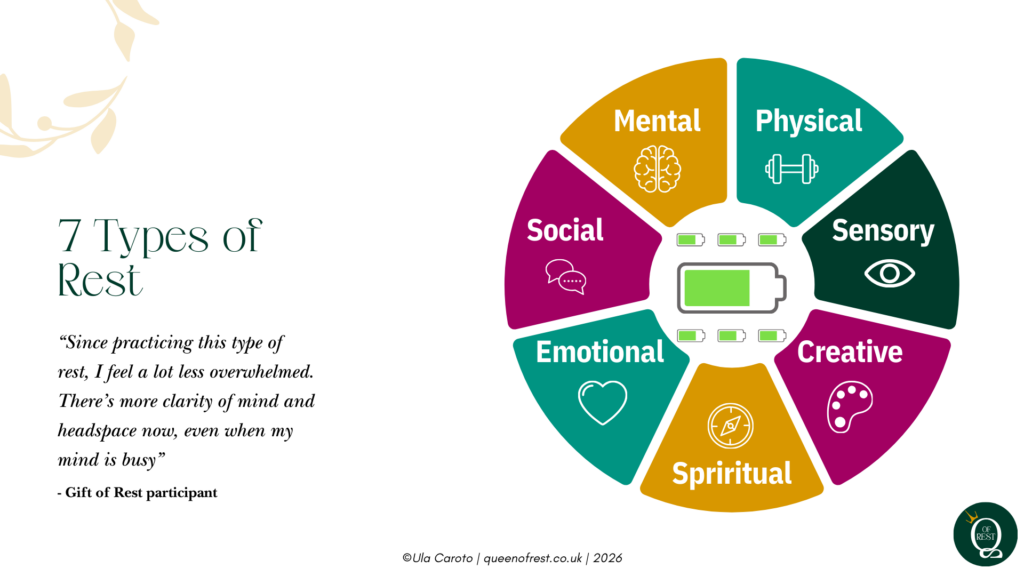
The seven batteries are:
- Physical — your body’s need to slow down, recover, and repair.
- Mental — relief from decision-making, overthinking, and constant cognitive load.
- Emotional — space to feel, process, and release — rather than absorb and hold.
- Social — time with people who genuinely restore you. And away from those who drain you.
- Sensory — a break from screens, noise, bright lights, and constant stimulation.
- Creative — permission to play, make, or simply do nothing — without it needing to be productive.
- Spiritual — connection to something larger than your to-do list. Purpose, nature, stillness, religion, awe.
Most high-achieving women focus on recharging just one or two batteries — usually physical and maybe mental (and that’s if they’re able to switch their mind off) — while the others are critically depleted.
This is why you can sleep eight hours and still wake up emotionally exhausted. Or take a holiday and return feeling creatively empty. Or have a full social calendar and feel utterly alone.
The right kind of rest depends on which battery actually needs charging.
Reflection: Which of your seven batteries is running lowest right now? And what’s one small way you could begin to recharge it today? And if you find it hard to feel into it, don’t worry. It can sometimes be challenging to do so. There is a process to it, and the first step is to take a pause, ask yourself the question and then be gentle with yourself no matter what comes up. And if that feels too challenging, I invite you to ask for help: from a friend, family member or a specialist.
Life Isn’t a Spring, Nor It is a Marathon. It’s a Series of Sprints.
You’ve heard the saying: life isn’t a sprint, it’s a marathon.
With respect — I disagree.
In my work as a Polyvagal-informed coach, what I see is this: life is a series of sprints. Intense periods of output, creativity, leadership, and care. Followed — necessarily — by recovery.
Think about a 100-metre athlete. Would you expect her to sprint a marathon every single day, without rest, without recovery, and still perform at her peak?
Of course not. It would be absurd.
And yet — this is exactly what most high-achieving women do. Every day.
Rest isn’t the opposite of performance. It’s the condition for it.
The women I work with who integrate intentional rest don’t slow down their impact. They amplify it. They make faster decisions. They access creativity more freely. They lead with more presence. They get more done — in less time, with less friction.
Because a rested nervous system is an efficient one.
Reflection: Where in your life are you sprinting without recovery? And what would one intentional rest interval make possible?
What Rest Actually Changes — Cristina’s Story
Sometimes the best way to understand what rest makes possible is to see it in someone else’s life.
Cristina is a changemaker — a mother of two and a founder reshaping the UK’s educational landscape.
When she came to me, she looked like the picture of success. Running a business, raising a toddler, pregnant with her second child, and on a mission to change the world of education.
But inside? She was anxious, depleted, and trapped in a pattern she hadn’t consciously chosen.
At age six, when her mother nearly died, her father told her: ‘You are now responsible for the household.’ He meant to empower her. But Cristina internalised it as a lifelong rule: everyone else’s needs come first.
Rest, to her, was lazy. Weak. Selfish. Sleep was the only form she recognised — and even that was loaded with guilt.
We worked together through the Cycle of Alignment (see Section 3) — starting with Rest and Restore, moving through nervous system regulation, and into deeper rewiring of the childhood conditioning that had driven her to exhaustion.
The shifts were profound.
She began setting boundaries — without guilt. She discovered forms of rest beyond sleep: emotional, creative, mental. She stopped giving from depletion and started giving from fullness.
Her words:
“I used to give from depletion. Now I give from fullness — and the people around me feel the difference. I have more energy to focus not only on my family and business but also on my mission.”
Cristina didn’t slow down her mission because of rest.
She became a more powerful leader because of it.
How Allies and Workplaces Can Support Women’s Rest
Rest isn’t only a personal practice. It’s also a cultural one.
If you’re a manager, leader, or colleague — this section is for you.
The women around you may be performing brilliantly while running on empty. You may not see it. They may not even say it. But the signs are there: the one who never takes a full lunch break, who responds to messages at 11pm, who says ‘I’m fine’ reflexively.
Here’s how you can help:
- Model rest visibly. Take your breaks. Leave on time. Talk openly about recovery. What leaders do, cultures permit.
- Protect boundaries around time. Avoid scheduling unnecessary early or late meetings. Respect time off as genuinely off.
- Replace urgency culture with intentional culture. Not everything is urgent. Chronic urgency is a nervous system tax — and women, who often carry invisible mental load, pay it disproportionately.
- Ask — and mean it. ‘How are you really doing?’ creates space. Then listen without fixing.
- Normalise rest as a performance strategy — not a reward for those who’ve earned it.
Rested women lead better. Create more. Stay longer. And change more.
The workplace that supports women’s rest doesn’t just retain talent — it unleashes it.
Permission, Power, and What Comes Next
Here’s what I want you to leave with.
Rest is not something you earn.
It’s not a reward for productivity. It’s not what happens when everything is done. It’s not selfish, indulgent, or weak.
Rest is your birthright.
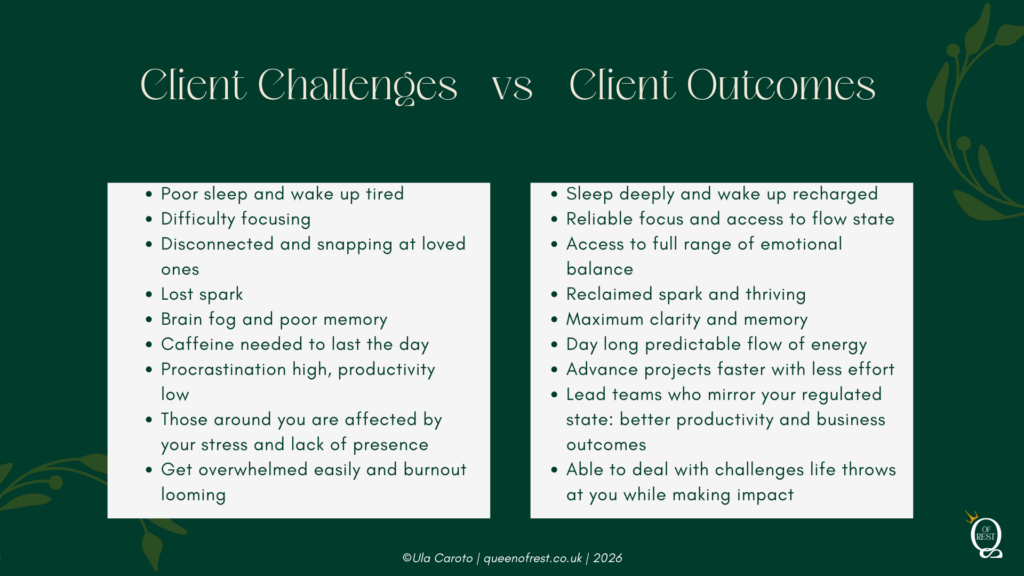
And here’s what actually changes when women access the right kind of rest:
🧠 Mind: Brain fog lifts. Clarity returns. Decisions come faster. Flow state becomes accessible again.
💪 Body: Energy stabilises. Sleep deepens. Hormonal chaos begins to settle.
❤️ Emotions: You move from reactive to responsive. From disconnected to present.
🎯 Performance: Procrastination drops. Productivity rises. More done, less friction.
👑 Leadership: You stop leading from stress — and start leading from strength. Your regulated state becomes contagious.
You go from surviving the week — to shaping it.
You don’t have to overhaul your life to begin. You just have to start — with one small act of self-permission.
That’s where the Cycle of Alignment begins.
One micro-rest to try right now:
Cup your hands gently over your eyes.
Take one slow inhale through your nose.
One long exhale through your mouth.
Notice what shifts — even slightly.
That’s your nervous system receiving the signal: it’s safe to rest.
Ready to experience 7 Types of Rest in 7 Days? Sign up for the 7 Types of Rest series: https://queenofrest.co.uk/7typesofrest